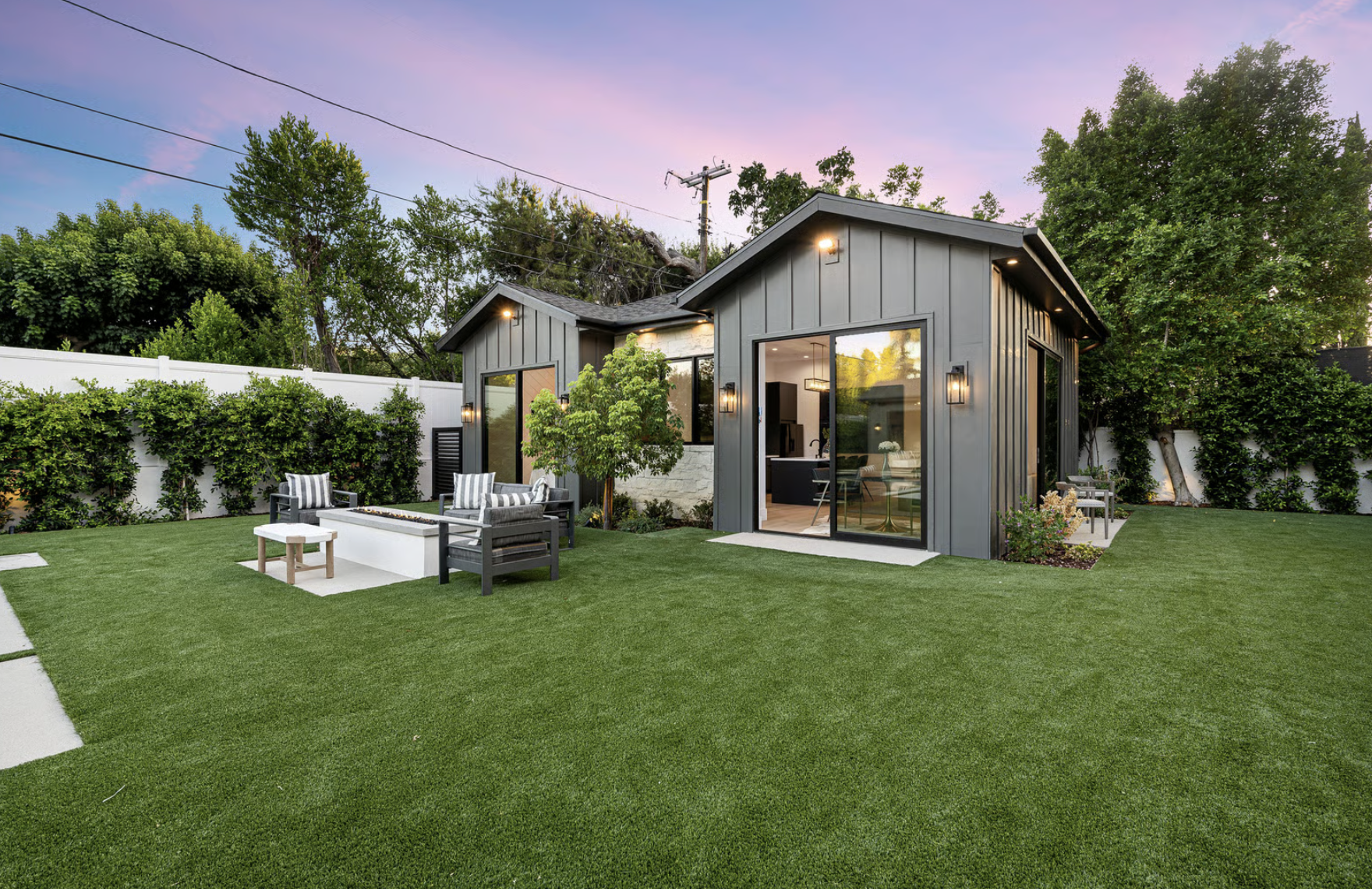
Accessory dwelling units—commonly called ADUs, granny flats, in-law suites, backyard cottages, or secondary units—have become an increasingly visible part of the residential housing market. Located on the same property as a primary residence, an ADU may be detached, attached to the main home, or created by converting existing space such as a garage, basement, or upper floor.
For real estate investors, an ADU can create another source of rental income without requiring the acquisition of a separate parcel. However, the feasibility and potential return depend on local regulations, construction costs, market rents, financing, and how the additional unit affects the property’s value and operation.
Investors should evaluate an ADU as a complete development project rather than assume that adding another unit will automatically produce a favorable return.
ADUs can add housing within established neighborhoods while making more efficient use of existing land and infrastructure. The U.S. Department of Housing and Urban Development has identified ADUs as one potential way to expand housing supply, and a growing number of state and local governments have revised their rules to encourage their development.
Demand does not follow a single national pattern. ADU construction activity, tenant demand, allowable uses, and property values vary significantly among states, municipalities, and neighborhoods.
Potential uses for an ADU include:
An ADU may also increase a property’s marketability or value, but investors should not rely on a standard percentage premium. According to Freddie Mac’s appraisal guidance, the market’s response to an ADU must be supported through relevant comparable properties and other available evidence. The effect on value can vary depending on legality, condition, design, functionality, rental demand, and local buyer preferences.
A legally rentable ADU may create an additional income stream from a property the investor already owns or plans to acquire.
The projected income should be based on comparable rents for similar units—not simply a percentage of the main home’s rent. Investors should consider the ADU’s size, privacy, parking, utility arrangements, finishes, outdoor space, and access when estimating rent.
An ADU may allow an investor to add a rental unit without purchasing another property. This can make better use of excess lot area, an existing garage, or underutilized interior space.
That does not necessarily make an ADU inexpensive. Site work, utility connections, permitting, design, labor, materials, and required upgrades to the primary structure can materially affect the project budget.
Two rentable spaces on one property may provide more income sources than a single-unit property. If one unit becomes vacant, income from the other may help offset a portion of the property’s expenses.
This arrangement does not eliminate vacancy or cash-flow risk. Both units remain exposed to local rental demand, property-level expenses, insurance costs, taxes, and regulatory changes.
For investors with suitable properties, ADUs may offer a way to increase unit count within an existing portfolio. A repeatable ADU strategy can be particularly useful when an investor has experience with local permitting, construction, leasing, and property management.
Before scaling, investors should confirm that their processes and financing can support multiple projects, overlapping construction schedules, and unexpected cost increases.
There is no reliable national construction-cost figure that applies to every ADU. Costs vary based on:
A garage conversion may cost considerably less than a new detached structure, but conversions can still uncover foundation, electrical, plumbing, moisture, or code-compliance issues.
Investors should obtain property-specific estimates from qualified professionals and maintain an appropriate contingency reserve. The budget should also include financing costs and lost income during construction.
Before building or converting an ADU, investors should evaluate the project using conservative assumptions.
The analysis may include:
Investors should calculate the return both with and without projected appreciation. If the project works only when the property achieves an aggressive future valuation, the investment may have limited room for delays or cost overruns.
The completed ADU’s legal status can also affect value and financing. Lenders and appraisers may review whether the unit was properly permitted, complies with applicable land-use requirements, and can legally generate the income included in the investor’s projections.
ADU regulations are highly local and can change frequently. Some jurisdictions have streamlined approvals, reduced parking requirements, or published preapproved plans. Others impose restrictions related to size, setbacks, height, design, utilities, fire access, owner occupancy, or rental use.
Before committing to a project, investors should verify:
State-level ADU reforms do not necessarily eliminate every local requirement. Investors may benefit from consulting the planning department and working with an architect, contractor, attorney, or land-use professional familiar with the jurisdiction.
The appropriate financing structure depends on whether the property is owner-occupied or investment-purpose, whether the ADU already exists, and whether the project involves renovation or new construction.
Potential options may include:
Some property owners use cash, a home-equity loan, or a home-equity line of credit. These options may avoid replacing an existing first mortgage, but availability, rates, repayment terms, and borrowing limits vary.
Consumer-purpose financing is different from the business-purpose financing generally used by professional real estate investors.
Short-term bridge financing may be appropriate when an investor is acquiring or refinancing a property that requires renovation or an ADU conversion.
The lender may evaluate the purchase price, renovation budget, completed value, borrower experience, liquidity, permits, contractor qualifications, and proposed exit strategy. Construction funds may be advanced through draws as eligible work is completed and verified.
A detached ADU or a broader redevelopment project may require ground-up construction financing. The lender will typically review the plans, budget, timeline, permits, project team, value, and intended disposition or rental strategy.
CoreVest’s Ground-Up Construction Loan provides business-purpose financing for eligible residential construction projects. Whether a particular ADU project qualifies depends on the complete property and transaction structure.
Once an ADU is completed, legally rentable, and stabilized, an investor may consider refinancing into a long-term rental loan.
A DSCR loan generally evaluates the property’s ability to support its debt through qualifying rental income. The treatment of income from an ADU depends on the lender’s guidelines, appraisal, leases, legal status, and property configuration. Investors should confirm how the proposed lender will classify the property and calculate qualifying rent before beginning construction.
Experienced investors pursuing repeated acquisitions or renovation projects may consider a line of credit. An established facility can provide borrowing capacity across multiple eligible properties, subject to property-level underwriting and approval.
CoreVest’s Line of Credit supports experienced investors acquiring, refinancing, renovating, or aggregating eligible residential investment properties. Investors should confirm that the proposed property type, ADU scope, budget, and exit strategy meet the facility’s requirements.
ADU projects may experience material shortages, contractor delays, permitting issues, change orders, or unforeseen site conditions. A realistic schedule and contingency reserve can help investors respond without disrupting the entire project.
The cost of constructing an ADU does not necessarily equal the value it adds. Limited comparable sales or rental data may make the completed value more difficult to support.
Adding another dwelling unit may change the property’s replacement cost, insurance requirements, assessed value, and tax obligations. Investors should discuss the completed configuration with their insurance provider and tax professionals.
Operating two rental units on one parcel can create additional responsibilities related to tenant screening, maintenance, shared spaces, parking, noise, utilities, and privacy.
Lease documents should clearly address which areas and services each tenant may use and which party is responsible for utilities, landscaping, and other shared expenses.
A jurisdiction may restrict short-term rentals, require long-term occupancy, change local fees, or impose other operational requirements. Investors should not assume that a legal ADU can be used for every type of rental strategy.
A completed project may not qualify for the expected refinancing proceeds if its value, rent, legal status, or debt-service coverage differs from the original projections. Investors should identify alternative exit strategies before closing on short-term financing.
The financing market is continuing to adapt as ADUs become a more established part of the housing stock. Conventional mortgage programs have expanded certain policies for properties with ADUs, while private lenders may evaluate ADU construction, renovation, or stabilization as part of a broader business-purpose investment strategy.
Further growth may encourage more standardized appraisal methods, construction programs, preapproved building plans, and financing structures. However, ADUs remain property-specific projects. Local regulations, valuation evidence, construction feasibility, and rental economics will continue to determine whether an individual investment is viable.
ADUs can help real estate investors add rentable space, increase unit count, and make more efficient use of existing properties. Their potential benefits should be measured against construction costs, permitting requirements, management responsibilities, and financing risk.
Before moving forward, investors should confirm that the ADU is legally feasible, obtain a detailed construction budget, analyze market-supported rents, maintain adequate reserves, and understand how the completed property will be valued and financed.
CoreVest provides business-purpose financing for residential real estate investors across the property lifecycle, including acquisition, renovation, construction, stabilization, and long-term rental ownership. Contact our team to discuss whether an upcoming property or ADU-related investment strategy may qualify for financing.
This article is provided for informational purposes only and does not constitute legal, tax, accounting, investment, financial, construction, real estate, or lending advice. ADU regulations, costs, property eligibility, financing structures, and rental restrictions vary by jurisdiction and transaction. All loans are subject to underwriting, credit approval, eligibility requirements, and applicable terms and conditions.
CoreVest Finance | NMLS #1627183