
Despite elevated interest rates and continued uncertainty around future Federal Reserve policy, liquidity in the real estate investor lending market remains strong. Capital continues flowing into residential investment lending, and institutional demand for investor-focused loan products remains healthy.
While today's environment looks very different than the low-rate market of just a few years ago, the ability to originate, securitize, and distribute investor loans remains intact. As a result, financing continues to be available across a broad range of investment strategies.
Here are four trends we're watching as we move through the second half of the year:
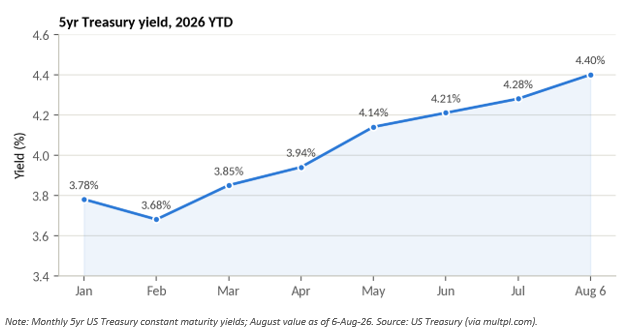
The Federal Reserve left rates unchanged in July, and market expectations continue to point toward a higher-for-longer rate environment.
Historically, elevated rates would be expected to significantly slow lending activity. Instead, investor lending markets have remained active. Capital providers continue allocating to residential investment lending, and financing remains readily available for both bridge and rental-property loan programs.
From a capital markets perspective, the important takeaway is that liquidity remains healthy. While higher rates may impact individual investment decisions, the broader funding ecosystem continues to function well, supporting continued loan production and execution.
One of the more noteworthy developments this quarter has been the addition of a second major rating agency, KBRA, to the bridge-loan securitization market.
While this may not be meaningful to the average borrower on the surface, it is an important development for the industry.
Additional ratings coverage can increase investor participation and improve confidence in bridge-loan securitizations. Over time, broader investor demand can contribute to deeper liquidity, more efficient execution, and potentially lower funding costs across the market.

One trend we've observed throughout the year is a continued shift away from traditional fix-and-flip activity and toward longer-term hold strategies.
Rather than purchasing a property strictly for renovation and resale, many investors are using bridge financing to acquire or stabilize assets with the intention of holding them as rentals before refinancing into permanent financing.
Several factors appear to be driving this shift.
Home sales activity has slowed in certain markets, and listing inventory can remain on the market longer than investors became accustomed to during the post-pandemic housing boom. At the same time, some borrowers have experienced longer exit timelines, creating additional carrying costs and pressure on project economics.
As a result, many investors are focusing on strategies that prioritize cash flow and long-term portfolio growth rather than relying exclusively on near-term appreciation.
That doesn't mean fix-and-flip activity has disappeared. It remains an important segment of the market. But investor behavior increasingly reflects a preference for flexibility and cash-flow durability.
Debt Service Coverage Ratio (DSCR) loans remain one of the strongest areas of growth in investor finance.
Unlike traditional consumer mortgages, DSCR loans are qualified primarily on a property's rental income rather than a borrower's personal income. As a result, they have become a preferred financing tool for many experienced investors building and scaling rental portfolios.
Investor demand for DSCR-backed securities has remained strong, and the product continues to attract significant interest from capital markets participants.
That demand matters because it supports liquidity and helps maintain competitive financing solutions for rental-property investors.
As more investors pursue rental-focused strategies, DSCR lending continues to play an increasingly important role within the broader non-QM and investor lending ecosystem.
The investor lending market continues to demonstrate resilience despite a higher-rate environment.
Funding remains available, securitization markets continue to support loan originations, and institutional demand for investor-focused products remains healthy. At the same time, investor behavior is evolving, with many borrowers increasingly focused on rental income, portfolio growth, and long-term cash flow.
In our view, the market is becoming more selective rather than less active. Investors who adjust their strategies to today's environment continue to find opportunities, particularly in rental-focused segments supported by strong capital markets demand.
If you're actively evaluating, connect with the CoreVest team to discuss your next investment opportunity or financing strategy.
Talk with a Lending Expert today: (844) 223-7496