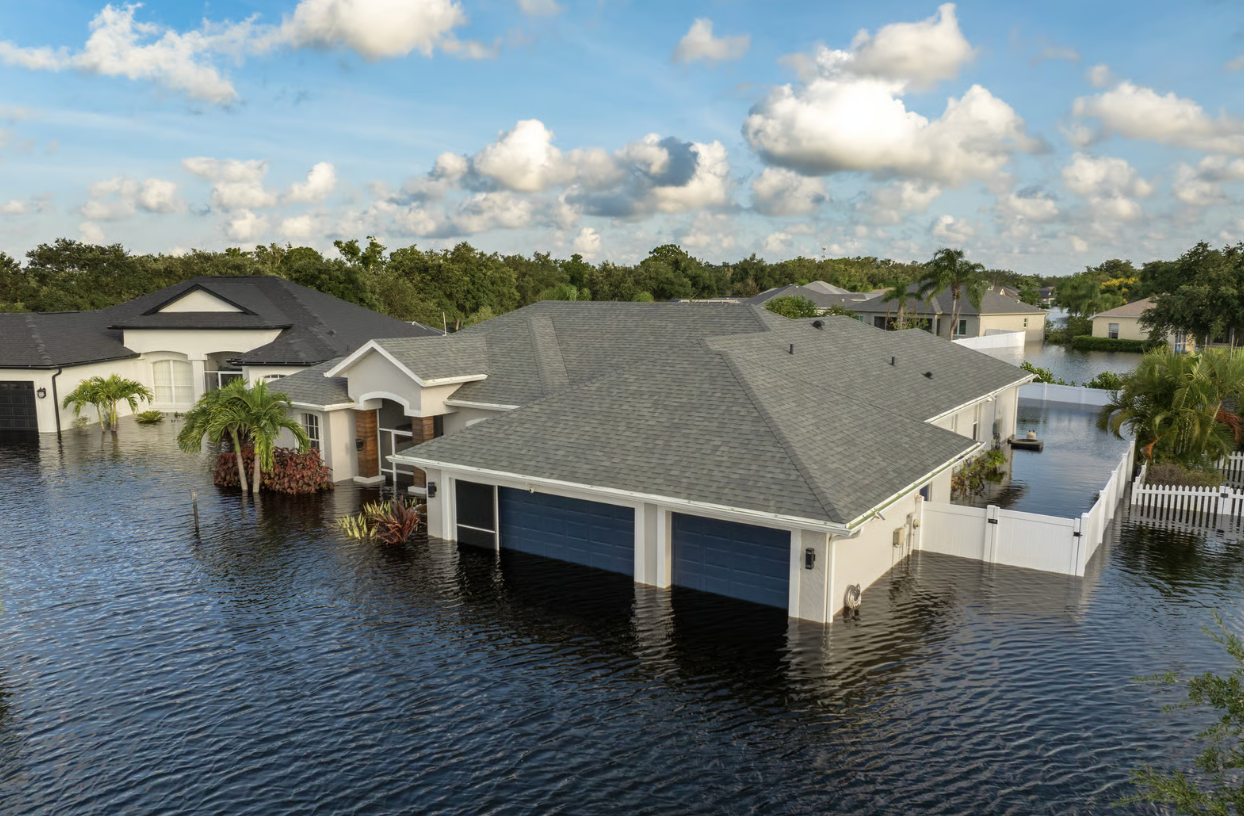
Hurricanes, wildfires, floods, earthquakes, tornadoes, and other natural hazards can damage a property with little warning. For residential real estate investors, the financial impact may extend beyond the cost of repairs to include lost rental income, tenant displacement, insurance deductibles, loan payments, and delays caused by shortages of labor and materials.
Insurance is an essential part of risk management, but having a policy does not necessarily mean every type of damage is covered. Investors should understand their policies, evaluate property-level risks, maintain appropriate reserves, and develop a plan before a disaster occurs.
The risks facing a rental property depend on its location, construction, age, condition, and surrounding environment.
Potential hazards may include:
Investors should review more than a property’s current hazard-zone designation. Development, drainage changes, wildfire damage, weather patterns, and updated mapping can alter risk over time.
FEMA’s Flood Map Service Center and National Risk Index can provide useful starting points. Investors should also review state and local hazard information, obtain inspections, and consult qualified insurance professionals.
A landlord or dwelling policy may cover physical damage to a rental property caused by specified perils. Depending on the policy, covered events may include fire, lightning, wind, hail, or certain types of water damage.
Coverage varies substantially. Investors should confirm:
The policy should be written for the property’s actual use. A traditional owner-occupied homeowners policy may not provide appropriate coverage for a non-owner-occupied rental property.
One of the most important limitations is flood coverage. Flood damage is not typically covered by standard homeowners or renters insurance, and investors may need a separate policy through the National Flood Insurance Program or a private insurer. Review the NAIC’s flood-insurance guidance.
Flood risk is not limited to properties located in designated high-risk areas. Investors should consider drainage, nearby waterways, elevation, prior losses, development patterns, and the cost and availability of coverage.
Flood insurance may also have a waiting period before coverage becomes effective. Investors should not wait until a storm is approaching to begin evaluating coverage.
Flooding is not the only hazard that may require separate coverage, an endorsement, or a specialized policy.
Depending on the property and location, investors should ask about:
Properties in coastal or storm-prone markets may have separate wind or hurricane deductibles. Some policies may exclude wind coverage or require it to be purchased through another insurer or state program.
Standard property policies commonly limit or exclude earthquake and earth-movement damage. Separate earthquake coverage may be available.
Wildfire may be covered under some property policies, but availability, pricing, deductibles, inspections, and mitigation requirements can vary. Investors should confirm coverage rather than assume all fire-related losses will be treated the same way.
Water entering through a backed-up sewer or drain may require an endorsement. This is different from flood coverage and should be discussed separately.
A damaged property may need to be rebuilt according to newer building codes. Ordinance-or-law coverage can help address certain additional costs that standard replacement coverage may not fully cover.
Standard landlord insurance may limit coverage when a property is vacant, undergoing substantial renovation, or under construction. Investors may need vacant-property or builder’s-risk coverage during these periods.
Investors should understand how a covered loss will be valued.
Replacement cost coverage generally pays the cost of repairing or replacing covered property with materials of similar kind and quality, subject to policy terms and limits.
Actual cash value coverage generally accounts for depreciation, which may result in a lower claim payment.
Even a replacement-cost policy has limits. If construction costs rise or the insured value is outdated, the available proceeds may be insufficient to rebuild the property.
Investors should review insured values periodically and ask whether extended replacement-cost, inflation-guard, or ordinance-and-law coverage is available and appropriate.
Damage can make a property temporarily uninhabitable even when the structure can be repaired. During that period, the owner may lose rental income while continuing to pay taxes, insurance, utilities, maintenance, and debt service.
Loss-of-rents or rental-income coverage may reimburse qualifying lost rental income when the property becomes uninhabitable because of a covered event.
Investors should confirm:
Loss-of-rents coverage generally applies only when the underlying damage results from a covered peril. A flood-related loss, for example, may not activate coverage under a landlord policy that excludes flooding.
Landlord policies may also include liability protection if a tenant, guest, or another person alleges bodily injury or property damage connected to the premises.
Investors should review liability limits across both individual properties and the broader portfolio. Depending on the size and risk profile of the portfolio, an umbrella or excess-liability policy may be worth discussing with an insurance professional.
Ownership through an LLC does not eliminate the need for appropriate property and liability insurance.
A landlord’s policy generally protects the owner’s interest in the building and covered landlord-owned property. It does not ordinarily insure a tenant’s personal belongings or provide the tenant with personal liability coverage.
Where permitted by applicable law and the lease, landlords may require tenants to maintain renters insurance. Requirements should be clearly documented and applied consistently.
Investors should understand that:
Landlords should consult legal and insurance professionals before establishing or enforcing renters-insurance requirements.
Investors should review each policy with a licensed insurance professional and ask:
Policy language controls coverage. Verbal explanations should not replace a careful review of the policy, endorsements, exclusions, and declarations.
A disaster plan should address the property, tenants, records, contractors, and available funds.
Maintain dated photographs or video of:
Update the documentation after major improvements or repairs.
Keep digital copies of:
Store copies securely in a location that can be accessed if the property or local office becomes unavailable. Ready.gov provides additional guidance for documenting and insuring property.
Emergency reserves may be needed for:
The appropriate amount depends on the property, policy, deductibles, debt obligations, and portfolio concentration.
Investors and property managers should know:
Life and personal safety should always take priority over protecting property.
Once authorities determine that it is safe to access the property:
Investors should not make unsafe repairs or enter a damaged structure without authorization from emergency officials.
Investors with multiple properties should evaluate whether their assets are concentrated in the same hazard area. A single hurricane, wildfire, or regional event could affect several properties simultaneously.
Portfolio planning may include:
A policy-by-policy review may not reveal the full exposure created by geographic concentration.
Federal disaster assistance should not be treated as a substitute for insurance. Eligibility, available assistance, and repayment requirements vary.
Property owners may also have tax questions after a casualty or federally declared disaster. The rules governing casualty losses, insurance reimbursements, basis adjustments, and timing can be complex. Investors should consult a qualified tax professional and review IRS Publication 547.
Insurance should be treated as an active part of property and portfolio management—not a document reviewed only at acquisition or renewal.
Investors should understand covered perils, exclusions, deductibles, valuation methods, rental-income protection, vacancy limitations, and lender requirements. They should also document their properties, maintain reserves, and establish a response plan before a disaster occurs.
CoreVest provides business-purpose financing solutions for residential real estate investors. Contact our team to discuss your property, portfolio, investment strategy, and financing requirements.
Speak with a CoreVest loan specialist
This article is provided for informational purposes only and does not constitute legal, tax, insurance, risk-management, investment, financial, or lending advice. Insurance coverage, exclusions, limits, deductibles, availability, and claims are governed by the applicable policy and law and vary by insurer, property, jurisdiction, and event. Investors should consult qualified insurance, legal, tax, and other professionals regarding their circumstances. All loans are subject to underwriting, credit approval, eligibility requirements, insurance requirements, and applicable terms and conditions.
CoreVest Finance | NMLS #1627183